
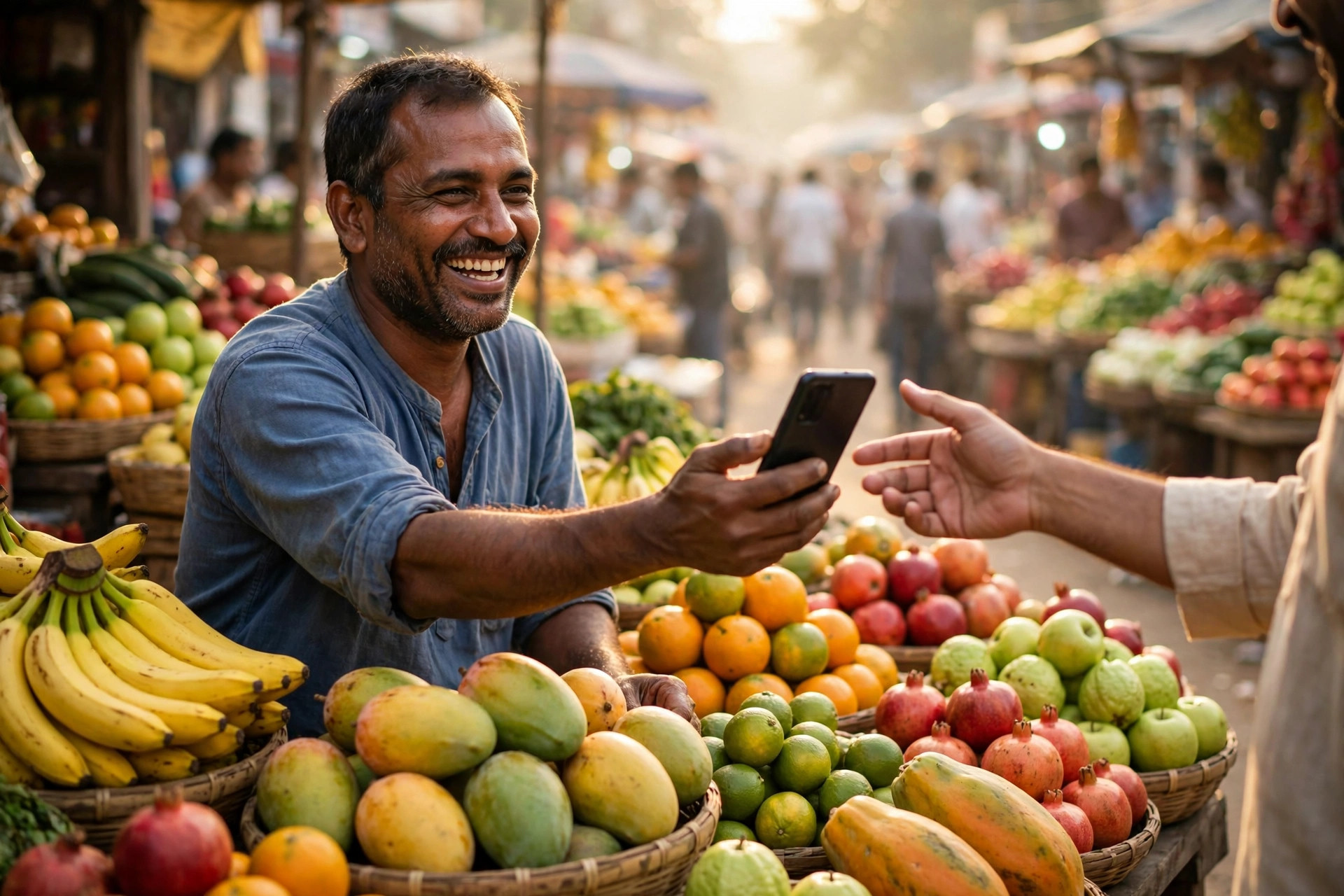
UPI is India’s instant payment system, and in ten years it has turned a phone number into a bank account for hundreds of millions of people. Built by the National Payments Corporation of India (NPCI) under the oversight of the Reserve Bank of India, the Unified Payments Interface lets money move between any two bank accounts in seconds, at any hour, usually free for the person paying. It launched on 25 August 2016. In the financial year 2025-26 it processed more than 24,162 crore transactions, about 241.6 billion, worth roughly 314 lakh crore rupees. In July 2026 alone it handled 23.66 billion transactions, the highest monthly total in its history. For a sense of scale, that is roughly 760 million payments a day in one country.
How UPI actually works
The core idea is disarmingly simple. Every bank account can be addressed by something a person already remembers: a mobile number, or a virtual payment address that looks like an email handle. To pay, you open any UPI app, pick a contact or scan a merchant’s QR code, enter an amount and confirm with a PIN. The money moves directly between bank accounts in real time, including on weekends and holidays. There is no separate wallet to top up and no card network in the middle. The apps compete with each other: Google Pay, PhonePe, Paytm and the government-built BHIM app all run on the same rails, so users can switch apps without changing banks. Behind the scenes, the number of banks live on UPI grew from 44 in its first year to 703 by 2025-26. Interoperability is the point. A customer of a small rural bank can pay a merchant whose account sits with a large city bank, and neither side has to care which app the other uses.
The QR code on every shop counter
UPI’s most visible triumph is the printed QR code taped to shop counters, fruit carts and tea stalls across India. Standardised interoperable merchant QR codes rolled out nationwide in 2018, and they turned the smallest seller into a digital merchant for the cost of a printout. A vegetable vendor does not need a card terminal, a monthly rental or a bank relationship beyond an account. The customer scans, pays and both sides get instant confirmation. This mattered because the alternative, cash, costs time and risk: counting change, carrying notes, losing a day’s takings to theft. UPI removed the fee barrier too. Peer-to-peer transfers and everyday merchant payments carry no charge for the person paying, and in almost all cases none for the person receiving either. When a payment system is free and instant, people stop asking whether a purchase is big enough to justify it. A cup of tea is as payable as a month’s rent.
Growth in numbers, and what drove it
The growth curve is hard to overstate. Annual transaction volume rose from 1.78 crore in 2016-17 to more than 24,162 crore in 2025-26, an almost 13,000-fold increase, according to India’s finance ministry. Value rose from 0.07 lakh crore rupees to about 314 lakh crore over the same period. Monthly volumes crossed 2,000 crore transactions for the first time in 2025 and passed 2,300 crore in May 2026. Several forces combined: cheap smartphones and data, a government push for digital payments, and the pandemic years, when contactless payment went from convenient to necessary. Later additions widened the net further. UPI Lite, rolled out in 2022, handles small offline payments without a PIN for each one. Linking RuPay credit cards to UPI let cardholders pay through the same QR codes. And in 2023, UPI was linked with Singapore’s PayNow, so people in both countries can send money across the border in real time. Brazil built something strikingly similar with Pix, its own instant payment system, and the two cases together show that instant, free, interoperable payments are a design choice, not a luxury for rich countries.
The parts that still need work
Scale has brought its own problems. Failed transactions and payment fraud rose with volume, and the system depends on phones, data and electricity, which are not equally available everywhere. Small merchants sometimes struggle with settlement delays or with customers who pay and then dispute. NPCI has had to set transaction limits and push better grievance handling, and banks invest heavily in keeping the rails up under peak load, such as festival shopping days. There is also a debate about who pays for “free”. Banks and apps bear the cost of running the system, and in 2026 a tax-law change opened the door to a possible narrow merchant fee in future, though the finance minister reaffirmed that UPI remains free for consumers. For Vietnam, where QR payments have already skipped past cards in everyday use, the caution is the same: free for users still has to be paid for by someone, and the funding model decides whether the system stays open to the smallest sellers.
What this means
UPI worked because it treated payments as public infrastructure, not as a product. One shared set of rails, open to every bank and every app, with no fee at the point of use, turned a country where cash was king into a place where a street vendor takes digital payment without thinking about it. The lesson for any country building digital payments is not to copy the technology, which is straightforward, but to copy the governance: interoperability by rule, zero cost to the user, and a regulator that keeps the rails neutral so that competition happens on top of them, not over who owns them.