
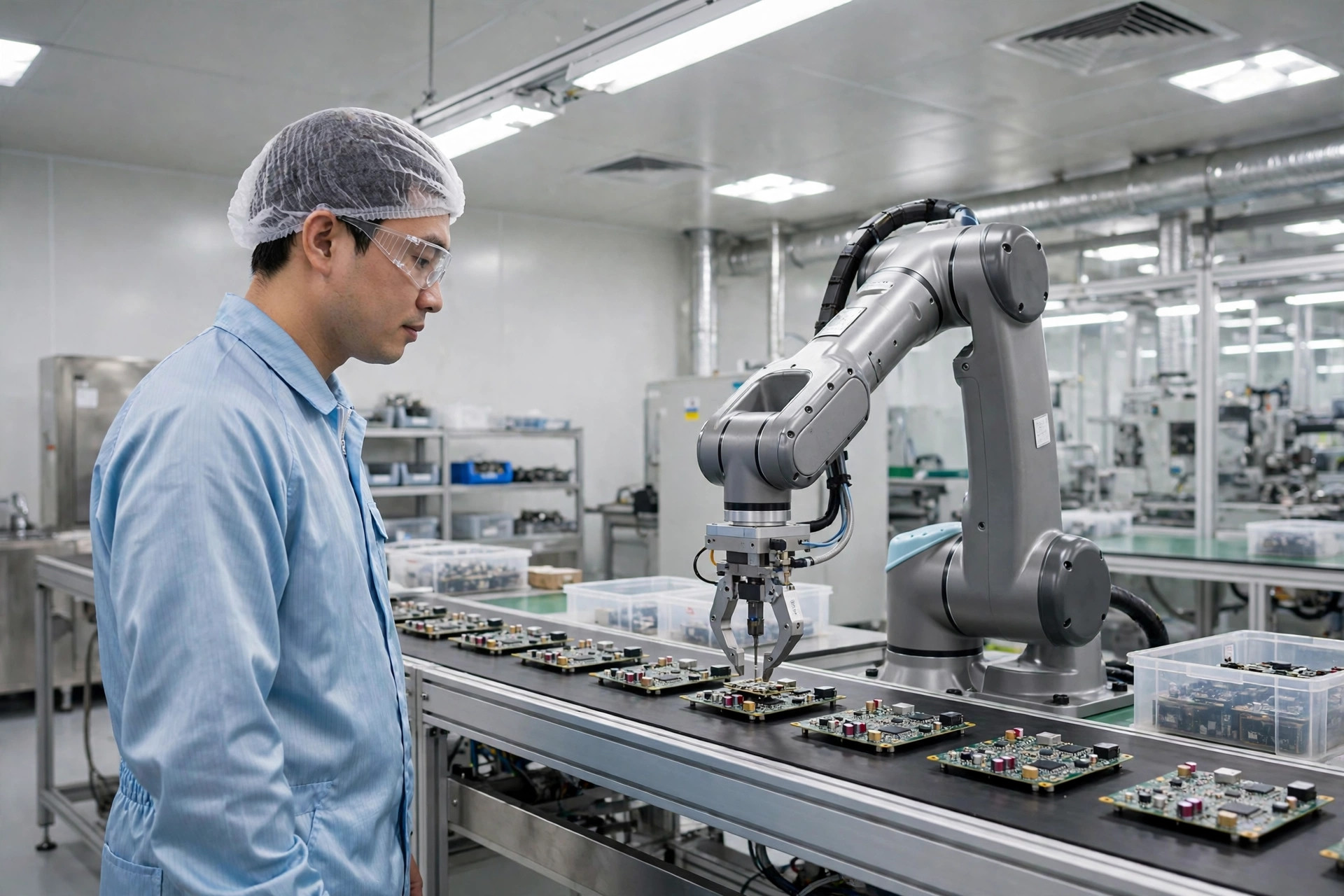
On a production line in Vietnam, a circuit board glides past a camera. In a fraction of a second, a computer compares it against everything it has learned about good boards and flawed ones, and decides: pass or fail. The camera has already moved on to the next board, and the next, tens of thousands of times a day. This is AI quality control in factories, and it is quietly changing what “made in Vietnam” means.
Vietnam’s factories grew by being fast, careful and cheap. But the products they make — phones, earphones, connectors, camera modules — have become so small and so precise that the defects that matter are invisible to a tired eye at line speed: a scratch a fraction of a millimetre wide, a solder joint that is almost right, a component seated one degree off. These are the faults that send a shipment back from a buyer in Japan or Korea.
The job human eyes were never built for
Traditional quality control relies on people. A line of inspectors watches products pass, checks them against a sample, and pulls the ones that look wrong. It works, up to a point. But people get tired, lighting changes across a shift, and two inspectors will disagree about the same borderline part. The best inspector on a good day catches most defects; the same inspector at the end of a long night shift catches fewer.
The economics sharpen the problem. Senior quality inspectors in Vietnamese manufacturing earn roughly 400 to 600 US dollars a month, and a high-volume line can need a team of five to ten per shift. When a defective shipment reaches a buyer, the penalty can run from thousands to tens of thousands of dollars depending on the order — and a factory that ships bad parts loses the next order, not just the last one.
The alternative is not to remove people from quality control. It is to give the repetitive watching to a machine, and keep people for the judgements a machine cannot make: what a new kind of defect means, whether a borderline part is safe, and how to fix the process that produced the fault.
How a camera learns what good looks like
An AI inspection system is, at its core, a camera, a light, and a trained model. Cameras mounted over the line photograph each item at line speed. A computer vision model — usually a neural network trained on images of good products and of known defects — classifies each image in real time, flags the faulty items, and logs the decision with the photograph attached.
Training data is the hard part. A model trained on defect images from a German car plant will not reliably recognise the surface flaws that matter on a Vietnamese electronics line, because the materials, the lighting and the product geometry are different. The training set has to be built from the factory’s own line: thousands of images of good parts, and every defective part the factory can find. Newer systems also learn from good parts alone, flagging anything unusual.
Lighting deserves more attention than it gets. Factory light in Vietnam is often fluorescent, mounted at angles that differ from textbook industrial setups, and a model that works under one lamp can fail under another. Getting the optics right is often half the project, and the reason the best installations are built on the line rather than bought off a shelf.
Real lines already running in Vietnam
The technology is not a pilot anymore. At an electronics manufacturing site in Vietnam, A.I.MATICS — a vision-AI company that grew out of Hyundai’s in-house venture — runs its AIM-T1 inspection system on a connector-assembly line. The company reports up to 75,000 inspections a day, a 26 percent productivity increase, and a defect-escape rate of 0.01 percent. Those are the company’s own figures, and they should be read as a vendor’s report rather than an independent audit — but the direction is consistent with what other deployments show.
Another deployment comes from LSK iRobot and its AI subsidiary One Touch AI, which installed a vision inspection system on a production line at Nano Chemtech Vietnam. The company says inspection time per part fell from ten seconds to half a second, detection accuracy rose from a manual range of 70 to 95 percent to 98 percent, and inspection staffing could fall by about 80 percent. The system analyses surface reflections from multiple lighting angles to build a three-dimensional picture of each part, which lets it spot shape defects a flat photograph would miss.
Behind these named deployments sits a much larger, quieter shift: large electronics assemblers in provinces like Bac Giang run machine vision across their lines to check phones, earphones and components at volumes no human team could match. Local integrators such as FPT Software and CMC Corporation supply the systems and the support, adapting global vision technology to Vietnamese factory floors.
What changes for the people on the line
The honest question about AI inspection is what happens to the inspectors. The short answer is that the job changes shape rather than disappearing. A line that once needed ten people watching parts now needs two or three: one monitoring the system, one handling the parts it flags, and one training the model on new defects. Those are better jobs, but they need different skills.
Factories that handle the transition well invest in that retraining, because the system is only as good as the people who teach it. Every defect the model misses has to be photographed, labelled and fed back into training, and every false alarm has to be investigated, because false alarms slow a line just as surely as missed defects.
Smaller factories face a different problem: cost. An entry-level vision installation — a camera, an edge computer and model training — typically runs from 15,000 to 40,000 US dollars, and most manufacturers report payback within eight to eighteen months when labour reallocation and fewer escaped defects are counted.
What this means
AI quality control in factories is not about replacing Vietnamese workers with cameras. It is about matching the inspection to the product: when the product is a millimetre-scale component made by the million, the inspector has to be a machine, and the human’s job becomes the one machines cannot do — understanding why defects happen and fixing the process that causes them. Vietnam’s advantage is that its factories are adopting this shift while their order books are full, not after losing them.
The same logic is spreading through the rest of the country’s industrial economy, from the technology reshaping logistics across a long, thin country to the software startups selling factory tools to the world. Quality used to be something a buyer discovered after delivery. Now it is something a camera proves, part by part, before the box is sealed.