
Logistics tech Vietnam relies on every day is the quiet system that moves a parcel from a warehouse in Ho Chi Minh City to a doorstep in Ha Giang, and a phone case ordered at midnight to a buyer who expects it tomorrow. Vietnam is a long, thin country, more than 1,600 kilometres from north to south, with two huge cities at opposite ends and a mountainous spine in between. Moving things across that shape used to be slow and expensive. Software, sensors and sorting machines are changing that.
A country shaped like a long corridor
Geography is the first problem any Vietnamese delivery has to solve. Hanoi and Ho Chi Minh City sit roughly 1,700 kilometres apart by road and together generate around three quarters of the country’s online orders, while between them lie narrow coastal plains, mountain passes and dozens of provincial cities. A truck that leaves Saigon on Monday may not reach Hanoi until Wednesday, and a parcel bound for a commune in the Central Highlands can spend longer on the last 100 kilometres than on the first 1,000.
The cost of that geography shows up in the national figures. The World Bank scored Vietnam 3.3 out of 5 on its Logistics Performance Index in 2023, ranking the country 43rd out of 139 economies and fifth in ASEAN. Yet logistics costs still run at roughly 16 to 17 percent of GDP, well above the world average of around 11 percent and far above Singapore’s 8.5 percent. Road transport carries about three quarters of all cargo by volume, while rail and air carry only a tiny share — so the country’s supply chains depend heavily on trucks, motorbikes and the software that plans their journeys.
The parcel boom that forced technology in
The pressure to modernise came from online shopping. Vietnam’s e-commerce market reached an estimated 32 billion US dollars in 2024, up 27 percent on the year before, according to the Vietnam E-commerce Association, and postal statistics put e-commerce parcels at about 2.4 billion items, up 30 percent year on year. That is roughly six and a half million parcels a day, most of them ending their journey on a motorbike.
At that volume, clipboards and phone calls stop working. A courier company that handles a million parcels a day cannot plan routes by hand, cannot sort by memory and cannot answer a customer who asks where their order is without a live tracking system. The boom turned logistics from a transport business into a data business.
Route planning, sorting and tracking
The most visible change is in route planning. Modern courier systems take every delivery address for a district, factor in traffic patterns, road closures and the size of each parcel, and produce a sequence of stops that keeps a rider moving forward instead of criss-crossing the same streets, re-planning on the fly when an address changes or a road floods. Industry reports credit automated sorting and AI-assisted route engines with cutting average delivery windows from around 48 hours to around 24 hours on the busiest corridors.
Inside the warehouse, the change is just as sharp: parcels travel on conveyor belts past scanners that read a label and divert each box to the right chute in a fraction of a second. Viettel Post, the logistics arm of the Viettel group, has opened automated sorting centres, and other large couriers have followed with their own. A sorting line that once needed dozens of workers reading labels by hand now needs a handful of people watching machines.
Tracking ties the whole chain together. Every scan — at pickup, at the sorting hub, on the truck, at the local depot — updates a single record that the buyer can follow on a phone. That sounds simple, but it changed the relationship between sellers and buyers in Vietnam. A shop owner in Da Lat can see exactly where a shipment to Hanoi is, and a buyer in Can Tho can plan around a delivery time instead of waiting all day.
Warehouses move closer to the customer
The second big shift is where goods wait before they are ordered. The old model was a few giant warehouses outside Hanoi and Ho Chi Minh City, with everything shipped outward. The new model adds smaller fulfilment hubs in provincial cities, so a popular item already sits in Da Nang or Vinh before anyone there orders it. Demand forecasting software decides what goes where, using past sales, seasonal patterns and even the weather.
This matters because the last stretch of a delivery is the most expensive part. Industry estimates put last-mile costs in Vietnam about 28 percent above Thailand’s, largely because deliveries are spread thinly across a long country. Putting stock closer to buyers shortens that stretch and lets sellers offer same-day delivery in cities that used to wait two or three days.
The last mile runs on two wheels
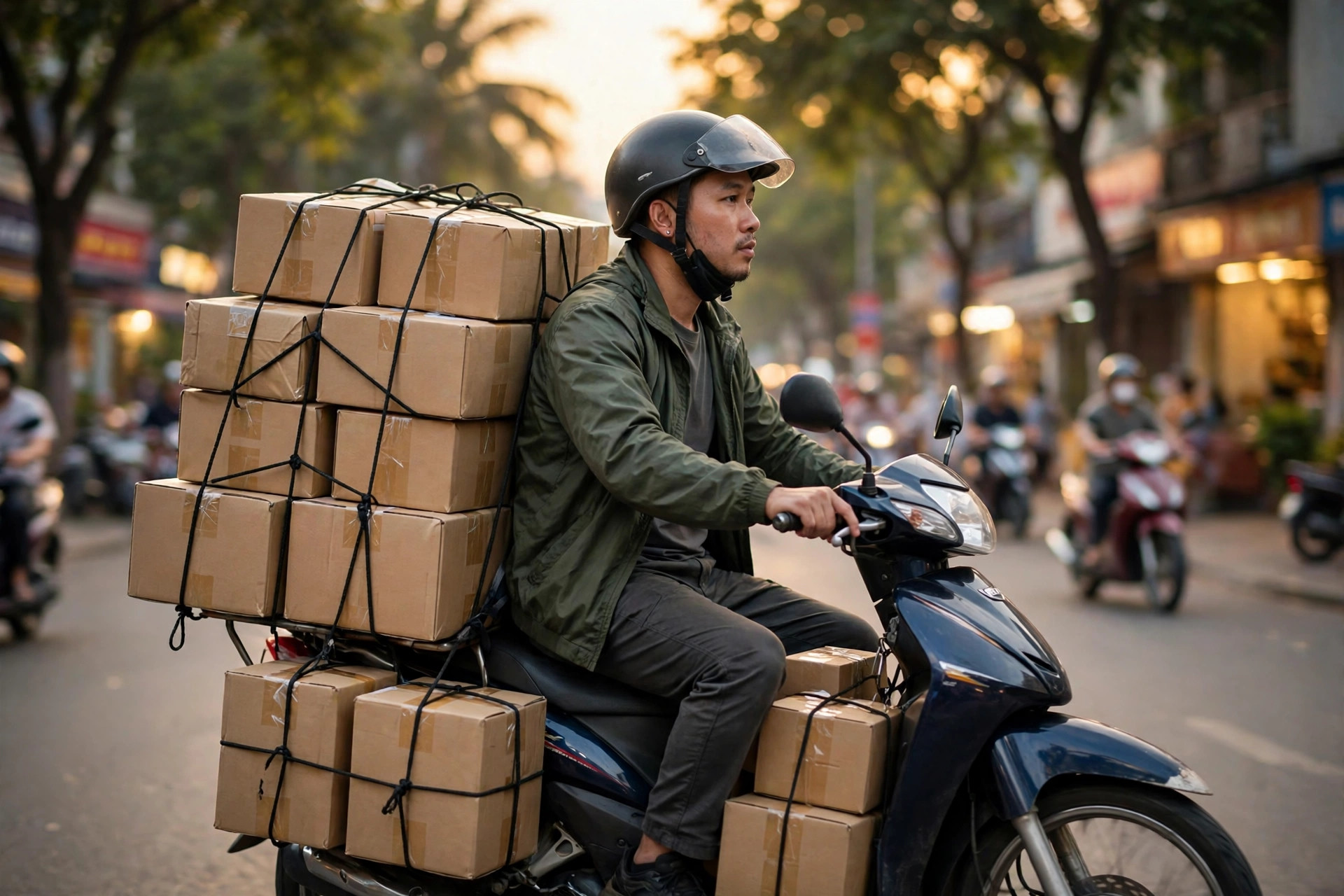
For all the software, the final step of a Vietnamese delivery is still usually a person on a motorbike. Narrow alleys, apartment blocks without clear numbering and customers who are out during the day make the last mile a human problem as much as a technical one: couriers call buyers, negotiate meeting points and remember which buildings have a guard who will accept a parcel. Apps support that work: they give riders a stop sequence, navigation and a way to confirm delivery with a photo, while customers get a message with a time window and the rider’s number.
Cash on delivery is still common, even as QR payments spread, so a rider is also a payment collector, and the systems behind them must reconcile cash, failed deliveries and returns. Returns are a real cost too: clothes that do not fit and electronics that buyers change their minds about flow back through the same network.
What still slows things down
Technology has not solved everything. The expressway network is still being built, so long-haul trucks share congested national highways with local traffic, and connections between ports, airports, rail terminals and warehouses are often awkward — a container can lose more time at a handover point than it spent on the road. Customs clearance for small parcels has improved, but paperwork still trips up smaller firms that lack digital systems of their own.
The workforce is another bottleneck. Running a modern logistics network needs planners who can read data and technicians who can maintain sorting machines, and many of the 34,000 logistics firms are small and family-run, with digital transformation still in its early stages. The national strategy aims to cut costs, but the gap between the leading operators and the long tail of small firms will take years to close.
What this means
Logistics tech in Vietnam is not about replacing people with robots. It is about giving a very human delivery network — riders, warehouse staff, truck drivers — better information, so each wastes less time and makes fewer wrong turns. The remaining work is unglamorous but important: better roads, better connections between transport modes, and digital tools that reach the smallest firms as well as the largest. The distance will never disappear, but the technology is making it feel shorter.
Sources
- Vietnam.vn — Removing bottlenecks to reduce logistics costs (World Bank LPI 2023, logistics costs 16–17% of GDP)
- Vietnam Logistics Review — Urban logistics in Hanoi and Ho Chi Minh City (e-commerce US$32 billion in 2024, 2.4 billion parcels)
- Mordor Intelligence — Vietnam Freight and Logistics Market (parcel growth, automated sorting, last-mile costs)
- B-Company — The growth of the logistics industry in Vietnam (LPI ranking history, modal shares)