
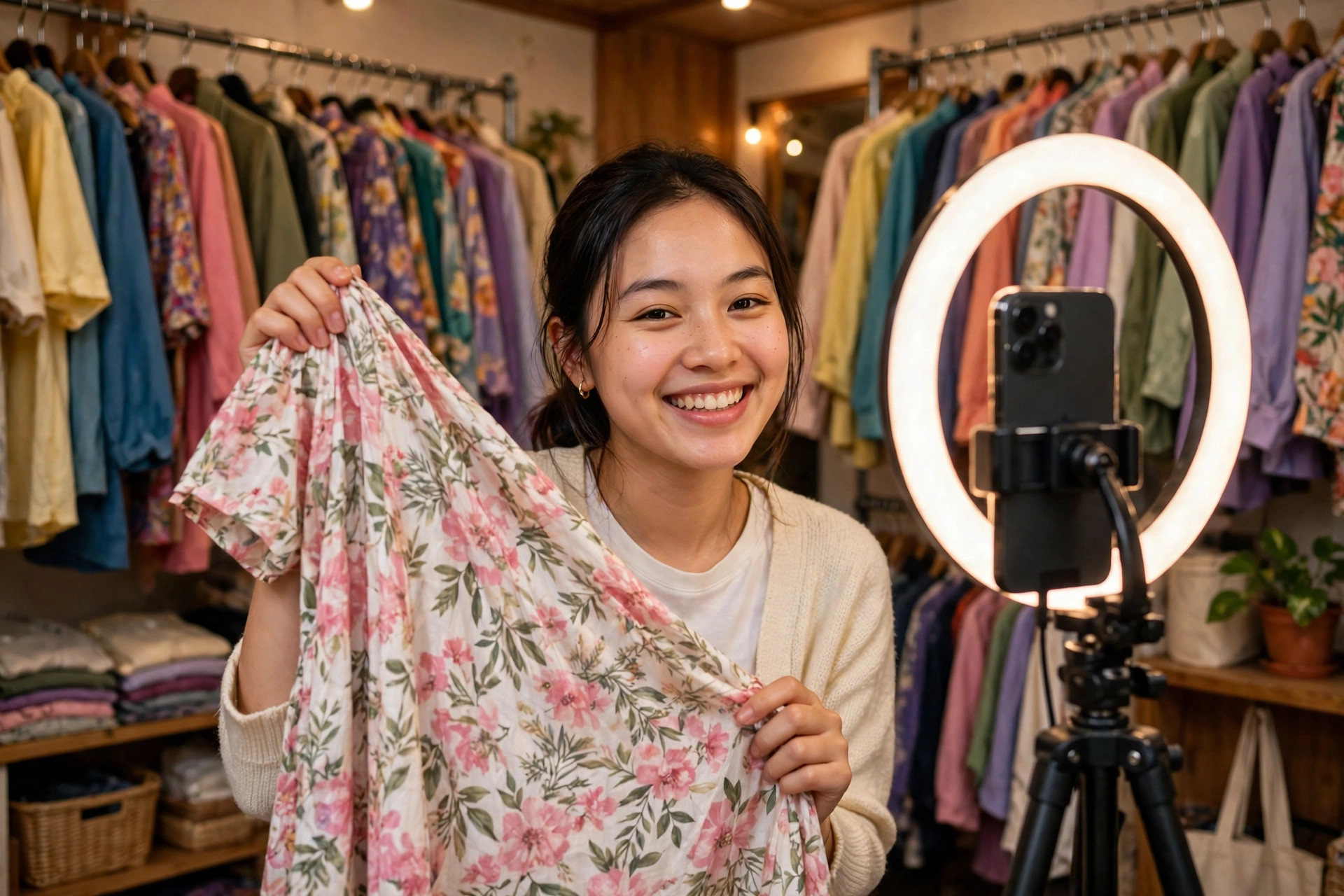
At eight in the evening in Ho Chi Minh City, a shop owner props up her phone, switches on a ring light, and greets a few hundred strangers by name. By nine, she has sold more dresses than her street shop sells in a week. Livestream commerce in Vietnam has turned the phone into a shop that never closes: a place where the seller is also the host, the model and the cashier, and where customers buy because they watched, laughed and trusted the person on the screen. It is the biggest change in Vietnamese retail since the market stall, and it runs on almost no capital at all.
The shop is a phone and a ring light
A livestream shop needs remarkably little. A phone on a tripod, a ring light, a rail of products, and an account on TikTok Shop, Shopee Live or Facebook. The seller goes live, holds up each item, answers questions in the comments, and pins a link to the product. Viewers tap, pay, and the order goes to the platform’s warehouse and delivery network.
The scale is now hard to ignore. Shopee and TikTok Shop together held about 97 percent of Vietnam’s e-commerce market in 2025, with combined sales of about 429.7 trillion dong — roughly 16 billion dollars — up 35 percent on the year before, according to analytics firm Metric. TikTok Shop’s share reached 41 percent, close behind Shopee at 56 percent. More than 70 percent of digital consumers in Vietnam now engage with live-stream commerce, and about half of them buy during a session. The audience is not a niche: it is the mainstream shopper, watching on the bus, during lunch, or in bed.
Why live beats a listing
A product listing is a photograph and a price. A livestream is a demonstration. The seller tries on the dress, stretches the fabric, shows the true colour under a bright light, and answers the question every buyer is thinking: will this fit me? That is why conversion rates for live selling run far above static listings — one industry summary put them at up to 2.5 times higher. Trust is the product being sold as much as the dress.
Live selling also creates urgency that a listing cannot. A price that lasts only for the session, a stock count ticking down on screen, a giveaway for viewers who stay to the end — all of it turns watching into buying. The chat does the rest: when viewers see other people ordering, they order too. And because the seller talks directly to buyers, the feedback is instant: a colour that does not sell is dropped by the next session, a style that sells out is reordered the same night.
The affiliate army
Not every seller goes live themselves. A large part of livestream commerce in Vietnam now runs on affiliates: creators who do not own the product, but earn a commission for selling it live. A creator with a loyal audience can host a session for a small brand, demonstrate its products, and take a cut of every order. TikTok Shop reported that the number of affiliate creators on its platform more than doubled in 2025, while short videos with shopping links grew 45 percent.
For a small trader, this is a way to sell without being on camera. Send samples to a few creators, agree a commission, and let their audiences do the work. For creators, it is a way to earn without holding stock. The risk is that the creator, not the brand, owns the relationship with the customer — and a creator who moves to a rival product takes the audience with them.
A day in the life of a live seller
Behind the cheerful hour on screen sits a working day that is anything but casual. A typical seller starts by checking yesterday’s orders and messages, packs the parcels, and hands them to the courier. Then comes preparation: choosing the products for the evening, checking prices against rival shops, writing the session plan, and setting up the lights. The live session itself may run two or three hours, talking almost non-stop.
It is tiring work, and the competition is brutal: the number of sellers on the four big platforms fell by nearly 7.5 percent in 2025, to about 601,800 shops, as fees rose and weaker sellers left. The ones who survive tend to share habits: they go live on a regular schedule so viewers know when to find them, they keep their product range narrow enough to know it deeply, and they treat the after-sales messages as carefully as the show itself, because a bad review on a platform can end a shop faster than a bad session.
The rules catch up
For years livestream selling grew faster than the rules around it. That is changing. Since 1 July 2025, e-commerce platforms in Vietnam have had to withhold tax on sales by individual sellers and household businesses — 1 percent value-added tax and 0.5 percent personal income tax on revenue — effectively turning the platforms into tax collectors. A new e-commerce law taking effect in July 2026 sets clearer responsibilities for sellers, live streamers and platform operators.
For small sellers, the practical meaning is that the informal days are ending. Sales are recorded, taxes are withheld automatically, and a shop that sells counterfeit or substandard goods faces enforcement — part of the reason seller numbers fell in 2025. A recorded sales history is what a bank wants to see before lending. The livestream shop is becoming a real business, with paperwork to match.
What this means
Livestream commerce in Vietnam has done something remarkable: it gave a market stall the reach of a television channel, at the cost of a phone. It rewards sellers who can talk, demonstrate and build trust, and it punishes those who cannot keep their promises. The platforms will keep changing their fees and their rules, and the tax office will keep formalising the trade, but the core of it will stay the same. A person, a product, and a crowd watching live — the oldest form of selling, rebuilt for the phone in everyone’s pocket.
Sources
- Vietnam Investment Review — Shopee and TikTok Shop account for 8 per cent of Vietnam’s retail market
- The Investor — Vietnam e-commerce rivalry intensifies as TikTok Shop surges, Shopee growth slows
- Invest Vietnam — The State of E-Commerce in Vietnam for 2026
- Digital in Asia — What is the State of Vietnam’s Digital Economy in 2026?
- How Vietnamese SMEs go digital on a small budget
- How digital banking helps small businesses in Vietnam
- How logistics technology moves goods down a long country